What to Do of a 6 Week Old Baby Hasn't Pooped in 2 Days
When information technology's been days since you concluding had to modify your baby's muddied diaper, y'all might begin to worry. Although, if you lot're honest, you may as well exist a footling thankful to accept avoided whatsoever public blowouts and poop-stained clothing.
Nosotros've all been at that place, wondering what's normal, worrying that our baby is uncomfortable, questioning the crusade of their possible constipation and how it volition touch them.
Knowing when you demand to take action can prevent much worry and empower you to make the all-time choices for your babe. So nosotros asked the experts and wrote this commodity to discuss how long breastfed and formula-fed babies can go without pooping. Nosotros'll also outline the signs, causes, and treatment of constipation and allow you know when y'all should consult your pediatrician.
- How Often Should My Baby Poop?
- What Causes Infant Constipation?
- Signs of Infant Constipation
- Relieving Infant's Constipation
- When Should I Worry?
- The Poop Scoop
How Often Should My Babe Poop?
Breastfed Babies
There is a wide range of normal for exclusively breastfed babies. Your baby might poop after every single feeding or get days — or even a calendar week or two — without a single poop (after six weeks of age).
During the first 24 hours of life, your babe's poop volition be a black, tarry substance called meconium. Breastfed babies should have at least three bowel movements, the size of a U.S. quarter, within their first 24 hours. As colostrum changes to mature milk, your baby's stools turn from black to light-green and then yellow, seedy, and loose (1).
Colostrum is a natural laxative, so exclusively breastfed babies volition poop a lot more often during the early days.
Take Note
After the first six weeks, your baby's bowel movements may decrease in frequency. Exclusively breastfed babies over two to 3 months of age can easily become i or two weeks without a poopy diaper.
Breastmilk is perfect for the human body and easily absorbed, then very piffling "waste" needs to be excreted from your babe's body. They use all those good nutrients from your milk to grow, leaving you with fewer poopy diapers to handle.
Formula Fed Babies
Baby formula is more than hard to digest than breastmilk. So it is typical for formula-fed babies to have fewer bowel movements than a breastfed baby during the beginning few months of life. Your formula-fed newborn should be pooping around three to five times a solar day.
Afterward the kickoff vi weeks, babies receiving formula typically have one bowel movement every mean solar day or every other twenty-four hours.
What Causes Babe Constipation?
There are a few possible reasons why your newborn may be constipated:
- Powdered formula: Formula often causes your baby'southward stools to be firm and bulky, especially if yous have the wrong ratio of powder to water.
- Dietary changes from breastmilk to formula: A simple alter from breastmilk to formula can disrupt your babe's digestive system and regularity.
- Allergy/food intolerance: Your baby might exist allergic or intolerant to the milk protein in your breastmilk or formula.
- Lack of fluid/dehydration: When dehydrated, babies' bodies blot all the fluids they ingest, creating hard, dry out stools.
- Concrete abnormalities: Physical abnormalities, such every bit rectum position, tightness around the anus, or an obstruction in the bowel system could be the culprit of your newborn'due south constipation.
- Illness or medical condition: Although rare, underlying medical atmospheric condition, such as hypothyroidism, botulism, or Hirschsprung'southward disease (a condition acquired during fetal development, affecting the function of the large intestine and making stools difficult to pass), could be the reason your baby is backed upwardly (two).
Signs of Infant Constipation
As mentioned above, the frequency of bowel movements can exist all over the map and still exist considered normal, and then this is not always a practiced indicator of constipation in infants. Hither are 8 other signs your baby may be constipated (3).
- Crying in pain when stool passes.
- Grunting when trying to poop.
- Bloating.
- More spit-upward than usual.
- Fussiness due to tum pain.
- Poop that is hard and comes out like rabbit droppings.
- Constant straining coupled with a business firm abdomen.
- Baby eating less.
Relieving Baby'south Constipation
If your babe seems unusually fussy, hasn't pooped in a while, has a business firm belly, and has no appetite, they may be constipated and need extra help to save themselves. Here are some ways to go your baby'due south bowels moving:
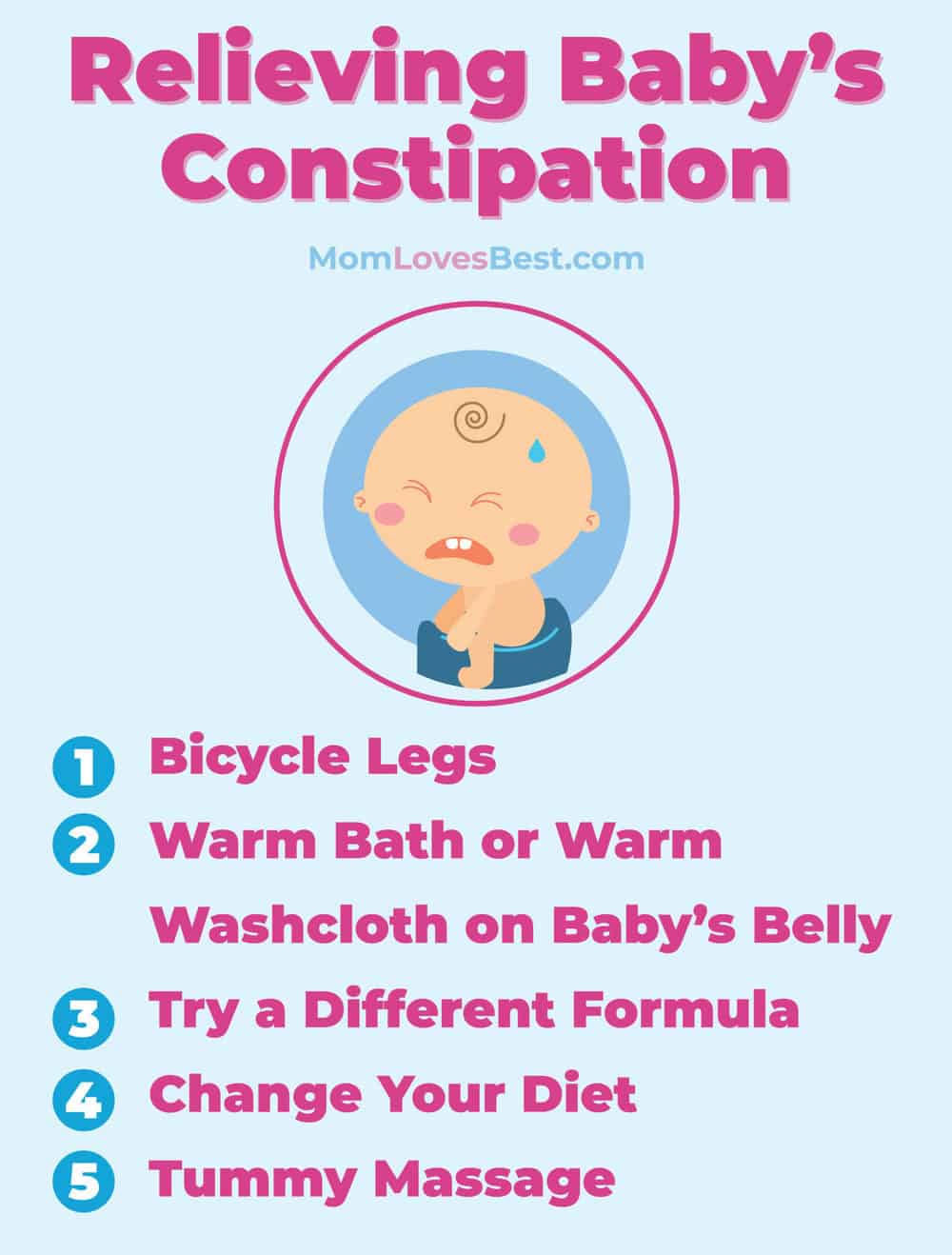
- Bicycle legs: Place your baby on their dorsum and movement their legs in a circular move, mimicking the motion of pedaling on a cycle. This should relieve some belly pressure and get things moving.
- Warm water bath or warm washcloth on baby's belly: This will relax and assist them release some of the bowel tension.
- Endeavor a different formula: Your baby may be reacting to ingredients in their formula. Try a different make or a different kind of formula, such equally a sensitive stomach, low-lactose, or even soy.
- Change your diet: If you are breastfeeding, your baby could be reacting to something in your diet. Effort eliminating dairy from your diet to encounter if that helps.
- Tummy massage: With your baby on their back, place your hands on their tummy right by the umbilicus and gently massage in a clockwise round motion. You may apply some babe lotion or oil, such as kokosnoot oil, while you lot massage for about three to five minutes.
If the tips above do non relieve your baby's constipation, talk with your babe's doctor nearly trying the post-obit:
- Take a rectal temperature.
- Give your baby some clip, apple, or pear juice.
- Apply a glycerin rectal suppository.
Take Annotation
Never employ mineral oil, enemas, or stimulant laxatives on your infant.
When Should I Worry?
Exist sure to visit your baby's doctor as soon every bit possible if none of the previous tips piece of work or if you notice any of the post-obit:
- Bloody or black stool.
- Mucus in the stool.
- White/dirt-colored stool.
- Persistent crying.
- Fever.
- Babe refuses to eat.
- Signs of dehydration.
- Baby is losing weight.
- Bowel movements look like rabbit droppings.
- Yellowish or green spit-upwardly or vomit.
Warning
If a babe is vomiting or spitting upwards bile and has a distended abdomen, take them to the emergency room as soon as possible as these are signs of an intestinal obstruction, which can be life-threatening (4).
The Poop Scoop
If your infant seems in pain, has difficult, pellet-like poops, or is constantly straining without results, they may need help to get things moving. Try warm baths, tummy massages, bicycling their legs, or even giving them a bit of prune juice for some relief.
Phone call your baby's doctor if nothing is working, if yous find blood in the stool, if y'all see signs of aridity, or if your babe has green/yellow vomit or spit-up.
Yet, if your baby is having fewer bowel movements merely seems happy and healthy, relax and enjoy the lack of poopy diapers.
Source: https://momlovesbest.com/health/baby-care/how-long-without-pooping
0 Response to "What to Do of a 6 Week Old Baby Hasn't Pooped in 2 Days"
Post a Comment